Several years ago, my mother, sister, and I became citizens of Italy through the law of jus sanguinis. Simply put, we were able to [easily] acquire citizenship because both of my mother’s parents were born there, and were still Italian citizens when my mother was born in the USA (this was a key component in the granting of our citizenship). This post is not meant to be about the application process, but if you are curious to know how that works, please let me know and I am happy to share my experience.
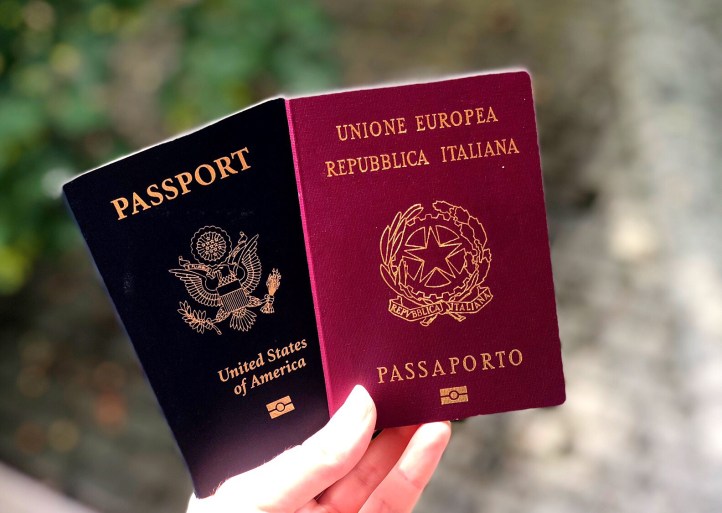
One of the perks of dual citizenship is holding a second passport, in this case, that of Italy, and therefore the European Union. Traveling with both passports in hand has presented me with many advantages – from skipping lengthy immigration lines to not having to apply for visas – and today, I would like to share the process by which I use two passports to travel.
Before considering any travel, I think one of the best resources to consult is the Passport Index. This is an incredible online tool that provides a wealth of information surrounding all of the passports on our planet. It explains why passports have certain colors, shares news stories about countries changing their visa requirements, and, it ranks every single passport by its global strength. Passport strength is determined based on how many countries a holder of that passport can access visa-free. Currently, the number one spot is held by the United Arab Emirates; the United States stands at number four. If you click on your country’s passport, you are brought to a new page that lists every country alphabetically, and you are given the entry requirements are for someone holding your particular passport (i.e. visa-free, standard visa, visa on arrival, electronic visa, etc.). Additionally – and this is a pretty neat tool – you can compare two passports and see which countries grant visa-free access to one passport but not to the other. When I first discovered this site, I immediately compared the United States passport to the Italian passport (which ranks higher). I was surprised to see that when traveling to Brazil, for example, I do not need a visa if I enter with my Italian passport, but I would with my U.S. passport. As it stands right now, I do not need any sort of visa to enter the European Union on my U.S. passport, but, starting in 2021, U.S. passport holders, along with other countries, will be required to apply for a visa waiver in order to enter the European Union as a tourist, just as EU citizens are required to apply for a visa waiver known as the ESTA in order to enter the United States as a tourist. Luckily, if you are a dual EU citizen, you’re in the clear. So, now, how does traveling with two passports actually work?
I do just want to provide a brief disclaimer that though this process is entirely legal, I am in no way offering advice that has been deemed official by any Customs and Immigration Officer or attorney. I am neither a Customs and Immigration Officer nor attorney, and I have never claimed to be one. I am simply providing advice based on my own personal experience.
1. Booking your flight – U.S. Passport. Pretty much a straightforward process, but keep in mind that when booking an international flight, the airline will ask you to input your passport information in order to ensure your eligibility to travel to your intended country, as well as use this information to match you with their records upon check-in for your flight at the airport. Typically, you can add this information at any time up until three days before your departure. So which passport info do you use? I once attempted to input the credentials from my Italian passport, but an error popped up stating that visa info would be needed to ensure that I was staying in the U.S. legally. Assumedly, because the ticket was being purchased from the United States, and I entered in my Italian passport info, the airline thought that I was a foreigner staying as a non-tourist in the U.S., and would therefore require more documentation to prove that I was here legally. So, the answer is your U.S. passport.
2. Checking in at your home airport – U.S. Passport. It’s time to go! When checking in at the airport for an international flight, you are required to present your passport to the airline representative. Seeing as your U.S. passport credentials were entered when booking the flight, this is the passport that you must present. Keep your EU passport in your purse, it’s not necessary until you actually land in the country to which you are traveling.
3. Security and boarding – U.S. Passport. Again, keep using your U.S. passport as your form of identification to present to the TSA agents and the boarding gate assistant.
4. Landing in the EU and arrival immigration – EU Passport. You have made it to your destination and your adventures await! First, however, you must suffer through the long passport control line at the airport. But wait! As an EU citizen, your immigration line is infinitely shorter, and with the new biometric technology that most of the larger international airports have installed, you do not even have to consult an immigration officer upon your arrival to the EU. When you arrive at passport control, the line is split into two groups – one for all EU passport holders, and one for all other passport holders. If you arrive at an airport that has installed the new scanning machines, you simply walk up to the machine and place your passport ID-side up on the scanner. The machine will read the passport and a set of doors will open (similar to gates at metro/subway stations). You walk into a small vestibule where there is a camera that you must look into, as it will then perform a Face ID scan. Once the scan is complete, the second set of doors opens and you are free to roam! If you arrive at an airport that has not yet installed the machines, you will simply consult an officer, who, in my past experience, merely glances at your passport to ensure that your face matches the photo, and then sends you on your way, sans interrogation about your travels or the country from which you are arriving.
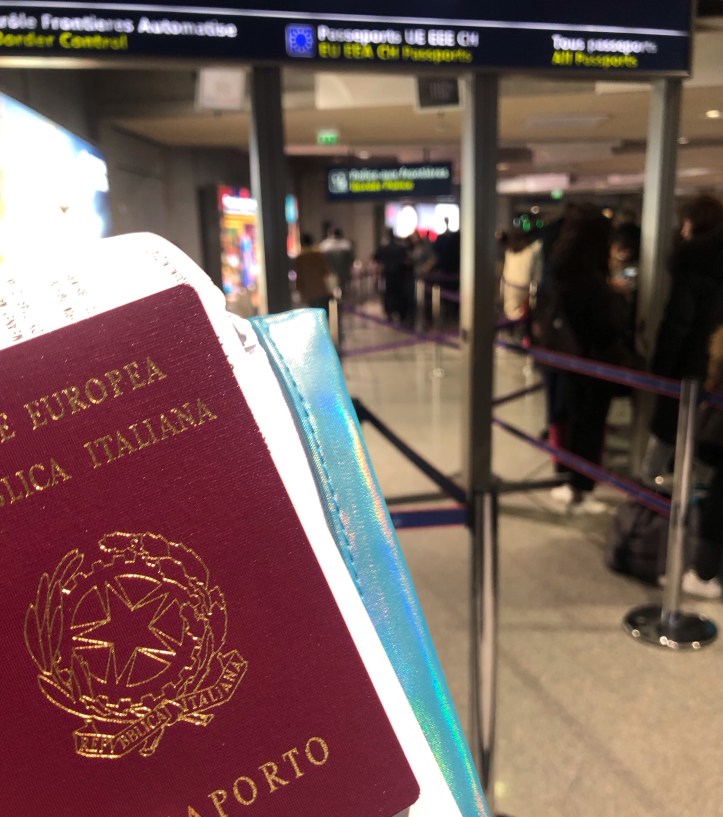
5. Checking in at EU airport for return home – U.S. Passport. Sadly, your travels have come to an end and it is time to return to the U.S. When checking in for your flight, be sure to present your U.S. passport to the airline representative. Again, the credentials pertaining to this passport were used to reserve the flight, so it is imperative that you keep consistent.
6. Leaving the EU and exit immigration – EU Passport. For some reason that I still have yet to figure out, no matter how many travel forums I have read, I cannot seem to understand why the EU has exit immigration and the U.S. does not. However, it is a necessity and you must pass through it before you even arrive at airport security. Much like arrival immigration, the line is divided between EU passport holders and other passport holders. Depending on the time of day you travel and from which airport, I have seen this area completely empty, or, by contrast, packed with hundreds of people. If you leave from a larger airport (i.e. Paris, Frankfurt, or Amsterdam, among others) and are doing so at a time where there are multiple international departures, I would highly recommend giving yourself an extra hour for this process if you are not an EU citizen or are traveling with someone who is not an EU citizen. Again, if you are a dual EU citizen, luck is on your side. Using your EU passport, once again, you will either use the passport scanning machine or briefly consult an officer upon your departure.
7. Arrival in the United States – U.S. Passport. Alas, you have finally made it home after a long flight. Now, for this final process, I can only speak to the American airports that have installed biometric machines as well, though I am pretty confident that most (if not all) of the major international airports in the United States have installed them. Gone are the days where you must fill out an arrival card upon landing, because that is now all done on a computer. For this process, you MUST use your American passport, as it is illegal as an American citizen to enter the country on a foreign passport (unless you can prove that you renounced your American citizenship). Again, you simply scan your passport and follow the prompts on the computer, which then prints out a receipt for you. You must hand this along with your passport to the officer. Now, in doing this, I remember that my major concern was that the officer would be looking for an entry/exit stamp from the country to which I traveled. However, that has not come up (yet), but I would in any case just present my Italian passport to the American officer and explain my position as a dual citizen. I can’t be the first dual citizen they have dealt with, and I know I will not be the last.
So, there you have it. It might seem wordy, but I have an unfortunate habit of sometimes providing far too much detail. I do hope my advice was helpful, and please do not hesitate to reach out with any questions, comments, or concerns. Lastly, if you have been considering applying for dual citizenship or you think you might be eligible and would therefore like to see a post about my experience, please let me know!
 Tales of Travels