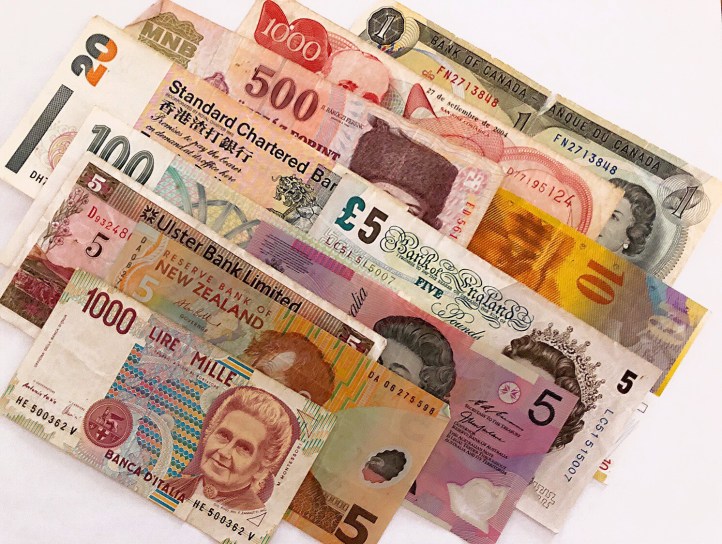
Dealing with foreign currency sometimes is more involved than we would like to think. You always want to make sure that the currency you will be using on your travels has a good exchange rate with your national currency, you want to budget enough to make sure that you exchange the right amount, and you hope to be able to use it all so that you are not left with any upon your return home. Here are some tips that I have found wonderfully helpful in exchanging foreign currency.
Before You Travel
Download XE – The official exchange rate website that provides rates in real time, updating itself every few seconds. Like most websites of the digital age, XE comes in an app version that you can download to your phone. If you are traveling to multiple destinations and will therefore be dealing with different currencies, you can add them all to the list on your homepage to see how they compare with your national currency. If you want the most updated exchange rate, this should be the only medium that you consult.
Budget for Travel – It is a good idea to know how much the average traveler spends per day in your intended destination. There is a great website called Budget Your Trip that gives the average spending amount per person, per day across thousands of destinations. Use this as a tool to gauge how much money you think you will need.
Prebook tours in advance – Are you planning on doing tours such as day excursions, museum visits, or food tours? Prebook all of that in advance using your credit card. In any case, tours should typically be booked online and in advance so you are guaranteed a reservation. It would be a disappointment to show up for a tour one day only to find out that it was full. Plus, once it has been paid for, you do not need to factor it into your daily spending budget.
Exchanging
So now, you exchange. Accommodations and tours are booked, you have done your budgeting, and now you are ready to exchange your money. So where do you go? Well, you have multiple options.
TravelEx – Probably the option I would advise against the most. These exchange bureaus are located in places like airports and shopping malls – basically where you would need them. Therefore, they tend to offer higher exchange rates, and typically charge a hefty service fee. If, however, you exchange a minimum of $500 USD, you will not have to pay the said fee.
ATM – Always an easy option because these machines are readily available and you are always receiving the current exchange rate. However, you must have your debit card activated internationally in order to be able to withdraw money, and you should check with your bank to know how much of a service fee you would be charged. With ATMs, it is definitely beneficial to withdraw larger sums of money at a time so you do not rack up as many fees. In any case, however, I think it is worth exchanging at least some cash before you depart for your trip, just in case your debit card does not work immediately upon arrival. You do not want to be stuck without any money.
Bank – Most major banks will exchange your U.S. dollars (USD) for foreign currency, but the key word is major, meaning that if you are a member of a local bank, it is likely that they will not be able to exchange money. If you are a member of a bank that can exchange money, you are in luck. They offer decent rates and typically will not charge a service fee if you are a member. If you are a non-member, it is likely that you will be charged a fee. Keep in mind that there are currencies that cannot be exchanged upon demand. Check with your bank to see if your currency needs to be ordered before you can exchange your USD.
AAA – Much like exchanging money at a bank – you must be a member, but you get decent rates and pay no service fee if you exchange a minimum of $200 USD. What is great about that too is that you can receive a mix of currencies in return if you know you will need them. It does not have to be $200 USD for each individual currency. However, with AAA, all currency must be ordered, meaning you must go in person to an AAA location, fill out an exchange form, pay your money, and return in 2-3 business days to collect your foreign currency. Make sure you factor that time needed into planning for your trip.
During Your Trip
Now, you are enjoying your travels, but you have unfortunately run out of the local currency. What should you do? Consider your situation. How much longer will you be needing this particular currency – one day or one week? Are credit cards acceptable to use? If you still have more than one day left, then I would recommend withdrawing money from an ATM. However, if you have a mere 24 hours left, then it might be worth it to try and get by with using your credit card, especially if you have one with zero foreign transaction fees. In most major cities, you really will not have a problem, as digital payments are widely and easily accepted – just make sure you know how much you are actually spending. However, if you are someplace rural, then again, the ATM might be your better option, if not the only option, as local businesses prefer cash transactions over those digital.
Exchanging upon Return Home
As the end of your trip nears, you might come to realize that you will have some money left over. What to do with the extra cash? Well, there are more options in this scenario.
If it’s enough, exchange it back – Upon your return home, you can always exchange your money back if you think it is worth it. This method works best with larger sums of money, or if you are exchanging a currency that is weaker than your national currency, and therefore will hopefully be getting more money back. For those however that are stronger than the USD, I would recommend exchanging the equivalent of at least $75 USD.
Keep some as a souvenir – I always love to keep the lowest-ranking bill from any foreign currency as a souvenir for myself. I have always found different forms of money to be incredibly fascinating, and I am quite proud of the growing collection that I have.
Donate spare coins (and bills) to homeless – Ah, coins. The bane of currency exchange existence because they cannot be exchanged. Do not come home thinking that your stack of 2 Euro coins will be accepted. Instead of coming home with a heavy wallet, maybe consider donating your spare coins to a person in need on the street. They could sure use the money and would be extremely grateful for your thoughtfulness.
Don’t forget the airport – Planning on eating or having a drink before you leave? Or purchasing some items at the duty free center? Use your extra currency to have some fun at the airport to help you think less about the sadness of going back home.
Save it – Especially the more common currencies like the Euro. You never know when you might be traveling back again, so if you think it is worth it, then hang on to your extra money for next time. Coming across money that you totally forgot you had is always a wonderful surprise.
Crowdsource your currency – Don’t have enough to make a worthwhile exchange when you come home and do not feel like saving it because you doubt you will need this particular currency again? Use the power of social media. Put a note out there and ask your friends/followers if they have any plans to travel to the destination from which you just came and are in need of that currency. See if you are able to meet up with them in person and perform an even exchange with your national currency – it beats having to go through a third party!
I hope these tips were able to be of help. Did I miss any? Or do you have currency exchange methods or tips that you find helpful? I would love to know!
 Tales of Travels